Separated but Organised: Digital Co-Parenting Tools That Actually Work
Co-parenting is challenging enough – poor organisation makes it harder. How digital tools reduce stress on parents and children alike.
Monday, 7:30 am. Finn is standing at the door with his school bag, asking whether he's going to Dad's or Mum's this weekend. You're not entirely sure yourself – something about Lena's birthday party had thrown the schedule off. Your ex sent you a WhatsApp last night, but you didn't have the energy to read it. Finn looks at you. You look at your phone.
This scene is familiar to many parents who raise their children together after a separation. Co-parenting works – but it needs a structure that holds even when communication between the adults is strained.
Why Co-Parenting Without Organisation is So Exhausting
Separated parenthood isn't failure. It's a different form of family life that needs its own rules. The problem: most families try to manage it with the same tools that were already overwhelming them – WhatsApp groups, sticky notes on the fridge, verbal agreements, and a shared Google Doc that nobody updates anymore.
What regularly gets lost along the way isn't just appointments. It's trust. When the school trip permission slip is at the wrong house, when the gym shoes are stuck at the other place, and when nobody knows whether the antibiotic has already been given – cooperation quickly turns into blame.
Kids sense this. Even when parents make an effort to stay calm, children pick up on the tension. Organisational chaos is never just logistical. It's emotional too.
The WhatsApp Dilemma
Let's be honest: WhatsApp has made co-parenting communication more accessible. But it hasn't made it better. Messages get buried. Agreements get misremembered. And because chat is also the channel for arguments, accusations, and old wounds, practical questions get tangled up with emotional baggage.
"Can you pick Finn up from school on Wednesday?" is a simple question – until it lands on top of an unresolved argument from the weekend. Suddenly the answer isn't "yes" or "no", it's a thread unravelling in the wrong direction.
Good digital organisation for separated parents separates the practical from the emotional. Not because feelings don't matter – but because Finn needs to know where he's going, regardless of how Mum and Dad are getting along right now.
What a Shared Digital Structure Needs to Deliver
When you start thinking about organising co-parenting digitally, it's worth pausing to consider what you actually need. From the experience of many families, the same core areas tend to come up:
A Shared Calendar – Transparent Across Both Households
The handover schedule, doctor appointments, school events, birthdays, holiday periods, activities at Grandma's. Everything needs to be visible to both parents – ideally in real time, without anyone having to actively "send" an update. When Mum adds a new paediatrician appointment, Dad should be able to see it immediately. Not after the next WhatsApp exchange.
Shared Task and Shopping Lists
Who's buying new gym shoes? Who's ordering the missing textbook? Who's returning the form? Shared to-do lists stop tasks from simply disappearing – or being done twice because nobody knew the other had already handled it.
Shopping lists are especially useful when children move between two homes and certain things are "over there" when they're needed "here".
A Document Safe for Important Records
Vaccination booklet, health records, school reports, custody agreement, health insurance card. In many co-parenting families, these documents are scattered – sometimes with one parent, sometimes the other, sometimes nobody can find them. A shared digital document safe that both parents can access solves this quietly and without drama.
Clear Communication – Without Mixing Channels
Ideally, there's a dedicated channel for organisational matters – not the same thread where relationship topics are discussed. That might sound cold, but it isn't. It protects children from their logistics becoming the stage for adult conflict.
How Pack Planner Can Help
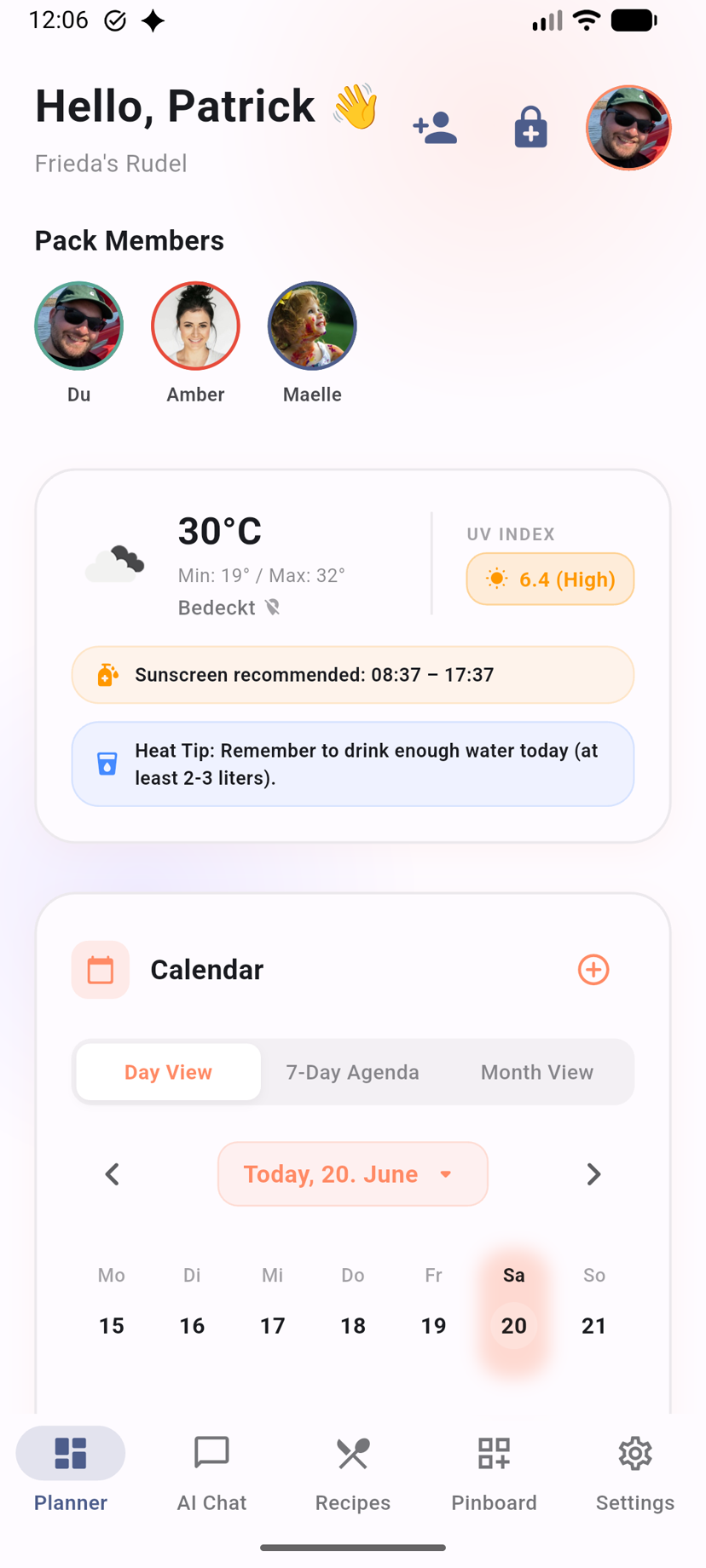
Pack Planner was built as a family organiser – for all family shapes, including co-parenting. The app runs on iPhone, iPad, Android and in the browser, and changes reach both households in real time. The shopping list, lists and chores even work without a connection and sync once you're back online.
For separated parents, this means both households can be connected through a shared family space. The shared calendar shows appointments for all family members, shopping lists and to-dos sync live, and the built-in document safe stores important records with end-to-end encryption.
The free version covers what co-parenting needs: the shared calendar, lists and chores, and inviting the other parent, grandparents or new partners at no cost and without a limit. Several families – "packs" – can live side by side, so each household keeps its own space. Premium (€4.99 a month) adds an unlimited document safe and two-way Google Calendar sync.
Worth noting: Pack Planner's data is hosted in Germany, and the document safe is encrypted on your device with a password only your family knows. For families sharing sensitive documents, that's not a small detail.
Practical Tips for Getting Started
Keeping the start simple is important – especially if the separation dynamic is still fresh or communication remains tense.
Begin with the calendar. The handover schedule is usually the most pressing issue. When both parents share the same calendar view and changes appear instantly, most "when exactly is...?" conversations become unnecessary.
Create routines rather than rules. Agree on a fixed time to check the shared calendar each week – Sunday evenings, for instance. That takes the pressure off spontaneous coordination.
Involve children at the right level. Older children can have their own view of the family calendar. It gives them a sense of control and reduces the questions they direct at parents.
Don't try to do everything at once. If a new app is supposed to take over calendar, shopping lists, documents, and communication all at the same time, it can feel overwhelming. Introduce one feature at a time, let it settle, then add the next.
What Children Actually Need
Children in co-parenting families don't need perfect logistics. They need the feeling that their parents – even though separated – are working as a team for them. When Mum knows the swim class fee has already been paid by Dad. When Finn isn't asked "Did Mum give you the form?" because both parents can see it in the same document safe. When handovers are smooth because both adults have the same information.
These are small things. But they add up. Children sense when parents cooperate – even without a single word being said about it.
Organisation Isn't a Luxury
There's a common idea that good co-parenting organisation should come naturally when the will is there. But that's not how it works. Good intentions and poor systems create friction, just as poor intentions and good systems do. Both together – the will and the structure – is where co-parenting can become calm.
Digital tools don't replace conversations and compromises. But they remove unnecessary friction. And less friction means more energy for what actually matters: the kids.
If you're looking for a simple, privacy-conscious way to organise your co-parenting setup, give Pack Planner a try. The app is free to download on the App Store and Google Play. Find more information and download links at pack-planner.io.
Try Pack Planner for free
No credit card, no commitment. Download and see if it fits.