Why the Family Shopping List Always Fails (And How to Fix It)
Duplicate milk, forgotten diapers, four different lists – why family shopping lists fail and how a shared system finally brings order to grocery chaos.
The Classic Monday Evening Moment
You're standing at the supermarket checkout, the conveyor belt is moving, the cashier is already waiting – and that's when it hits you. You forgot the butter. Again. It was on your list. The list that's now sitting on the kitchen table. At home.
Meanwhile, your partner is unpacking the shopping they grabbed on the way home from work. Three litres of milk. You still have a litre and a half at home. And the butter? They didn't get it, because you were obviously going to pick it up.
Welcome to family shopping list chaos.
Why One List Never Seems to Work
The problem isn't that parents are forgetful. The problem is the system – or more precisely, the lack of one.
Most families are juggling several parallel worlds at once: Mum keeps a list in her head. Dad has an app on his phone. The kids shout requests into the void. And the fridge communicates its contents only with itself.
What happens next is entirely predictable. Things get bought twice. Other things fall through the cracks completely. And at least once a week, someone stands in front of an empty fridge and asks: "Do we actually have pasta?"
The Paper Problem
The classic shopping list stuck to the fridge works – as long as everyone actually uses it. As long as nobody goes shopping without first checking the kitchen. As long as the handwriting is legible. As long as the list isn't hidden behind another magnet or fallen behind the cooker.
That's a lot of conditions to place on a piece of paper.
The App Problem (the Wrong Kind)
Digital shopping lists sound like a great idea at first. And they are the right direction – but only if everyone uses the same app. What often happens instead: Mum has one app, Dad has another, and they don't talk to each other. Or one person dutifully adds things, and the other never looks.
A list that isn't shared isn't progress. It's just a digital piece of paper.
What Families Actually Need
It sounds simple, but it's surprisingly rare in practice: one shared list that everyone can see and edit in real time.
Not two lists. Not a list plus "I'll tell you later." One list. Always current. For everyone.
The trick isn't just the technology – it's the habits that go with it. A few small shifts in behaviour make the difference between chaos and a system that works.
Habit 1: Add It Now, Don't Try to Remember
Opening the last pack of coffee? Add it to the list immediately. Noticing the shampoo is running low? On the list. Not "I'll remember," not "I'll mention it" – right now, in that exact moment.
It sounds fussy, but it makes an enormous difference. The fridge list fails precisely here: between the moment you notice something and the moment you write it down, life happens.
Habit 2: Stop Re-Writing the List Before Every Shop
How many minutes do you spend just before leaving for the supermarket gathering sticky notes, app reminders, and mental notes into one "proper" list? That time disappears entirely when the list already exists and is permanently up to date.
Habit 3: Check Off, Don't Delete
Why check off rather than immediately delete? Because you sometimes need to scroll back while shopping. Because having an overview helps. And because it genuinely feels satisfying.
How a Shared App Solves This
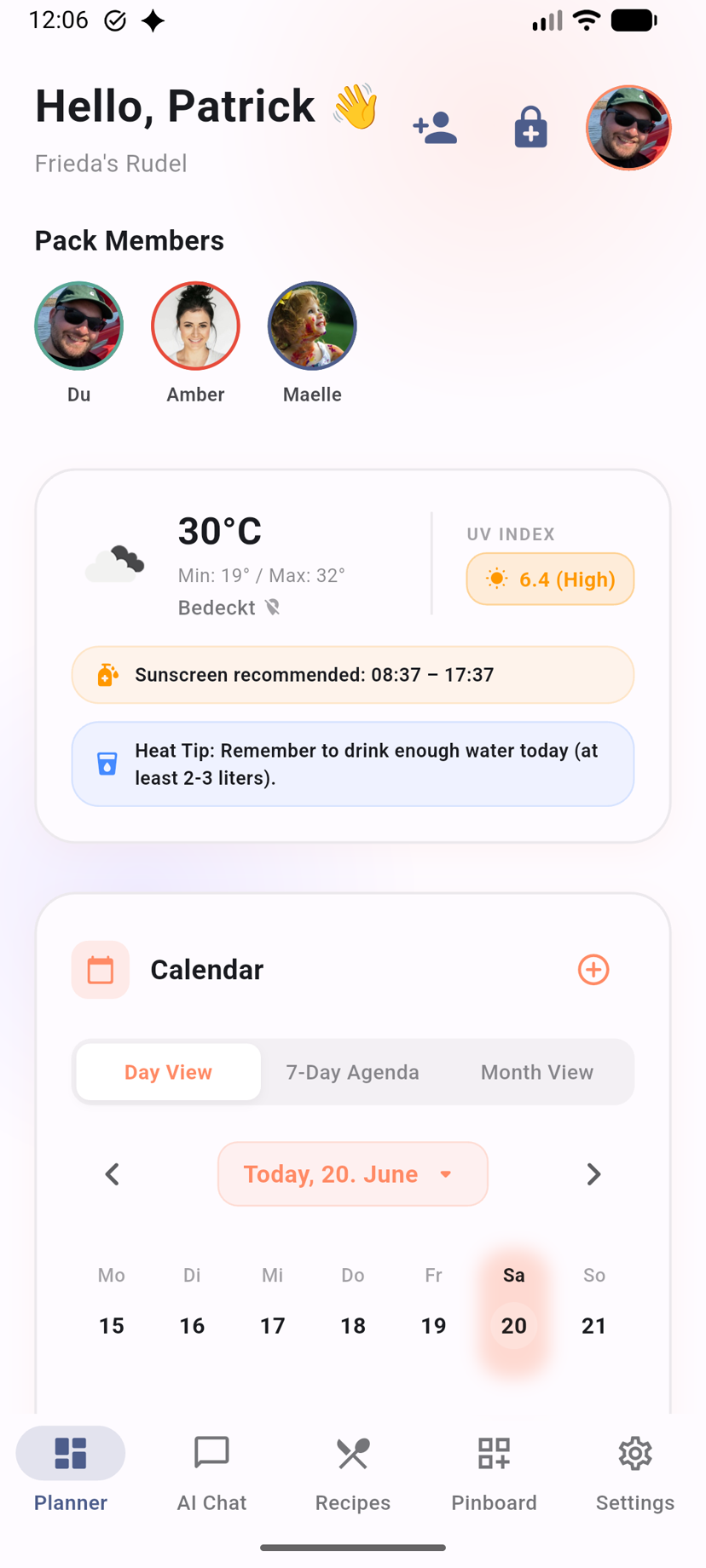
This is exactly where Pack Planner comes in. The app includes a shared shopping list that all family members can see in real time – on both iOS and Android. Someone adds milk, the other sees it instantly. Someone ticks off bread, it disappears for everyone.
That sounds unremarkable. But that's exactly the point: a good solution doesn't feel like magic, it just feels right.
What Pack Planner also does: the shopping list is connected to the rest of your family organisation. The meal planner, for example. When you know what's on the menu this week, you know what you need to buy. No more guessing, no more "what are we actually cooking on Wednesday?"
Offline-First – Because Supermarkets Have Weird Signal Situations
One practical detail that often gets overlooked: Pack Planner works offline. That sounds minor, until you're in the basement level of a supermarket with no signal and you realise your list is still right there.
The Meal Planner: An Underrated Hero
Shopping lists alone only solve half the problem. The other half is that question, asked at least once a day in households everywhere: "What are we having tonight?"
This question costs energy. Not much at once, but over the course of a week it adds up. It's part of what's often called mental load – the invisible work of constantly planning and deciding.
A meal planner for the whole week helps on two fronts: you decide once, not seven times. And you know exactly what to buy. No last-minute plan changes at the checkout because you've just realised you're missing one ingredient.
Pack Planner has a built-in meal planner that connects to the shopping list. Once you've used it, it's genuinely hard to imagine going back.
The Underestimated Problem: Multiple Shoppers, Different Habits
In many families, it's not always the same person doing the shopping. Sometimes it's her, sometimes him, sometimes a grandparent or older sibling. And everyone knows the products slightly differently – which brand, which size, where it lives in the shop.
A good shopping list should be able to handle this. Categories help enormously: fruit and veg, dairy, frozen, household. Shopping by category means less back-and-forth through the aisles and fewer things missed.
That's not rocket science, but it does require a system that supports it – not a scrap of paper with everything jumbled together.
When Kids Are Old Enough: Include, Don't Exclude
From a certain age, children can actively contribute to the family list. This isn't a parenting experiment – it's just practical. Whoever finishes the last of the cereal can add it to the list.
This only really works with a digital, shared solution. No child is going to voluntarily write on a piece of paper stuck to the fridge. But an app? That's more their medium.
Pack Planner can be shared with as many family members as you like – including children, who don't even need their own phone. Inviting is free, with no limit on the number of people.
In the End, It's About the System
Forgotten groceries, duplicate purchases, the daily what's-for-dinner question – none of that means a family is badly organised. It means the system isn't right.
The good news: the system is easy to change. You don't need a miracle solution or weeks of restructuring. You need one shared list, a handful of small habits, and the willingness to stick with it.
Sounds basic. It is basic. But basic and effective aren't mutually exclusive – sometimes the simple thing is exactly the right thing.
If you'd like to avoid your next shopping disaster, take a look at Pack Planner. The app is free to get started, runs on iOS and Android, and the shared shopping list is one of the features families mention most. You'll find it at pack-planner.io, on the App Store, and on Google Play.
Try Pack Planner for free
No credit card, no commitment. Download and see if it fits.