Blended Families: How Organisation Actually Reduces Everyday Stress
Blended families juggle twice as much as others. Here
When "my" kids and "your" kids are supposed to become "our" kids
Friday evening. The kids from the first relationship arrive at five. Your partner's son has football training tomorrow morning and his kit is still at his dad's place. Your own child needs a signed permission slip for a school trip that you cannot find anywhere. And someone still needs to go shopping because the weekend is suddenly five people instead of two.
Welcome to the blended family. Wonderful, complicated, alive – and sometimes just a lot.
Blended families are no longer a fringe phenomenon. According to the German Federal Statistical Office, nearly one in three children grows up in a family structure that doesn't fit the classic model. And yet the majority of family apps, planners and advice books are still aimed squarely at the nuclear family: mum, dad, two kids, one home.
Anyone living in a blended family situation knows how useful that is. About as useful as a map of Munich when you're trying to navigate Hamburg.
What actually makes blended families different
The most obvious difference: more people, more coordination. But that's still the simple explanation.
What really makes life complex in blended families is the parallel systems. Two or more households, each with their own rules, routines and calendars. Children who move between these systems and inevitably leave clothing, school notebooks, chargers and toothbrushes behind – or show up with two of everything, depending on how the week went. Paediatrician appointments that clash with custody weekends. And step-siblings who are still figuring each other out while someone tries to get dinner on the table.
It's not that blended families are worse at organising. It's that they structurally have more to coordinate – with less shared history, fewer established routines, and often more adults involved who don't all live under the same roof.
Making the invisible visible
One of the biggest challenges is what researchers call "mental load" – all the small, invisible tasks that live inside one person's head and never make it onto a to-do list. Who has the sports bag today? When did the youngest last see a dentist? Do we still have shampoo for the kid who can't use sulphate-based products?
In blended families, this invisible weight multiplies. And it tends to land unevenly – most often on whichever adult does the most household coordination.
The first step toward relief is making the invisible visible. Everything floating in someone's head needs to come out – into lists, calendars, notes. Not because anyone is forgetful, but because no human being can reliably hold 47 parallel threads in working memory.
Ending the coordination chaos
"Did you get the doctor's appointment?" – "No, I thought you had it." – "When is your daughter coming next weekend?" – "I sent you an email about that."
Blended families often communicate across too many channels at once: WhatsApp, email, phone calls, notes on the fridge, verbal agreements nobody remembers precisely. This means someone is constantly asking, constantly explaining, and constantly feeling like they're missing something.
A shared information hub helps enormously. Not as a monitoring tool, but as relief for everyone. When all the people involved – including children, once they're old enough – can look at the same calendar, the same lists and the same notes, the constant back-and-forth fades. Or at least becomes a lot rarer.
Children in two households: making handovers calmer
The moments with the highest conflict potential are usually the handovers. Friday afternoons, Sunday evenings, after school holidays – moments when children move between worlds and adults have to exchange information, often under time pressure and sometimes with old tension simmering underneath.
What helps: less communication at those moments, not more. That sounds paradoxical, but it isn't. If the important information has already been shared beforehand – the appointment is in the calendar, the packing list for the weekend is ready to go, the note about the school trip was added days ago – then the handover conversation needs fewer words. And fewer words means fewer opportunities for misunderstanding.
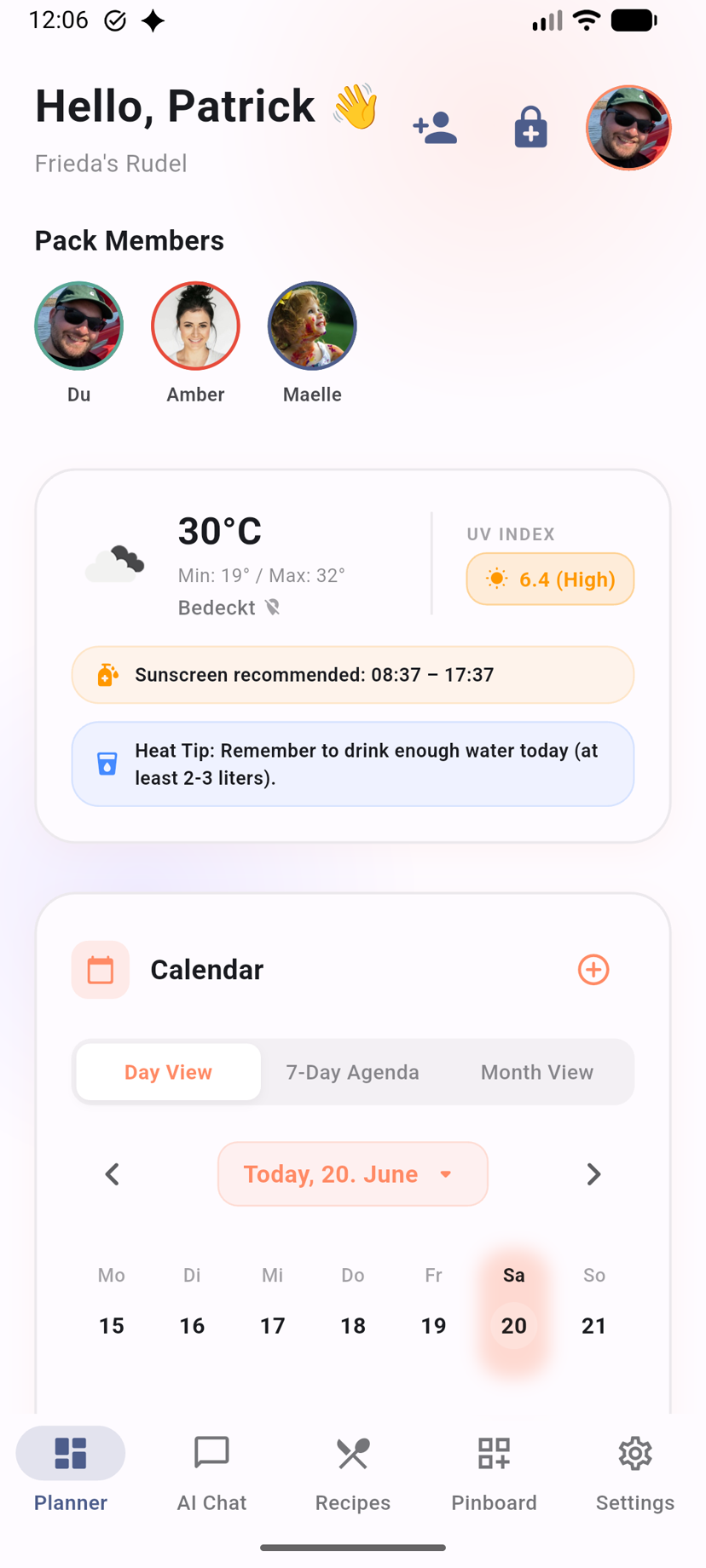
Pack Planner can help centralise exactly this kind of information. Shared calendars everyone can access. Checklists for custody weekends that don't have to be recreated from scratch every time. And a shared digital board where anything worth knowing is visible to everyone, without anyone having to actively send a message about it.
Stepchildren and biological children: fairness without sameness
One of the more sensitive topics in blended families is the sense of fairness. Children notice very precisely whether rules apply equally to everyone, whether everyone gets roughly the same attention, whether "his" kids and "her" kids are treated differently.
Organisation can't replace the emotional work that goes into building a blended family – but it can help surface unconscious imbalances. Who does which tasks? Who accompanies which child to which appointments? Who shops for whom? When this is documented, patterns become visible. And visible patterns can be addressed.
Shared rituals also need shared planning. The weekly film night, the monthly cooking session, the summer day trip – these things don't just happen. They need to be scheduled. And when they're on a shared list that everyone can see, they're much more likely to actually take place.
When the other household doesn't cooperate
Not every blended family situation is harmonious. Some co-parents barely communicate, others only through lawyers. In those cases, organisation becomes even more important – not as a bridge, but as a buffer.
When your own household is well organised, you're less dependent on information that may never arrive. Clothes in duplicate for both households, if the budget allows. Your own calendar entries for all known appointments, even those you were supposed to receive from the other household. And a document archive for everything important: vaccination records, school reports, medical letters – things you need and might not always be handed.
Pack Planner includes an end-to-end encrypted document safe. Files are encrypted on your device with a password only your family knows, so not even Pack Planner's servers can read them. The free version stores up to five documents; Premium gives you unlimited storage.
Small systems, big effect
Nobody needs a perfect system. Blended families especially – because life keeps shifting: new relationship phases, children getting older, jobs changing, people moving.
What helps are simple, robust systems that still work in stressful weeks. A shared calendar everyone trusts. A shopping list that's always at hand. A packing checklist for custody weekends that doesn't have to be reinvented every time. And a place for documents, so that in an emergency you know where to look.
That sounds unremarkable. But in a blended family, the fact that you no longer have to search for a vaccination record can rescue a Sunday evening.
Organisation isn't an end in itself
The point isn't that blended families need to be more organised than others. The point is that good organisation creates capacity – for the things that actually matter. For conversations that are difficult. For moments that are good. For the energy it takes to be truly present when the kids are there.
When you no longer have to think about who has the sports bag, there's more mental space for what's actually happening right now. And that, in the end, is the whole point of getting organised.
Pack Planner was built for exactly this kind of everyday life – for families in all their forms. Shared calendars, shopping lists, checklists, meal planning, a digital pinboard and secure document storage, all in one app. Everything you need day to day is free, including inviting a partner and as many family members as you like. Find out more at pack-planner.io.
Try Pack Planner for free
No credit card, no commitment. Download and see if it fits.